
Historical reconstruction or re-enactment? Learn to tell the difference
In recent years -and especially with the advent of artificial intelligence- initiatives that seek to represent the past have multiplied. Historical reconstruction and historical recreation have become key tools for dissemination in a wide range of formats: from academic publications to documentaries, audiovisual productions and cultural events. In this context, new technologies have introduced innovative ways of visualising and interpreting history, sometimes blurring the line between the two concepts.
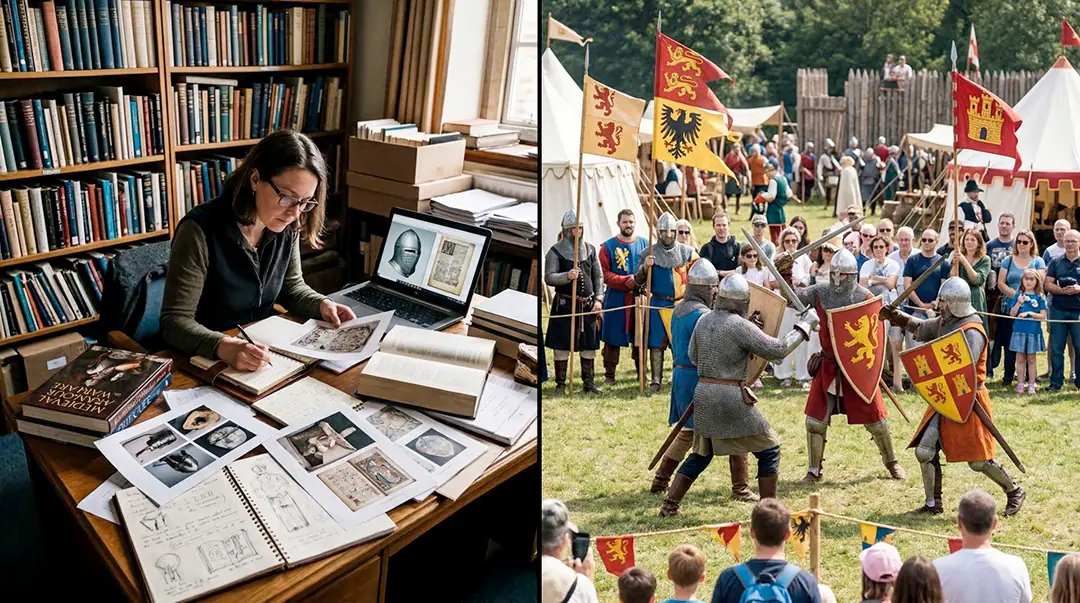
Historical reconstruction is based on documentary sources and rigorous analysis, while historical re-enactment represents the past in a visual and informative way.
Historical reconstruction and historical re-enactment are not the same thing. Reconstruction seeks to reproduce the past as faithfully as possible from historical and archaeological sources, while re-enactment depicts events or ways of life of the past with an informative approach. Although both share the same objective-to bring us closer to other times, their methods, levels of rigour and contexts of use are different.
Understanding this difference is not just a question of terminology. It allows us to better appreciate the research and documentation work carried out by professionals and specialised projects that invest time and effort in bringing other eras closer to us with the greatest possible rigour. In this article we will look at what really distinguishes historical reconstruction from historical re-enactment, What are their objectives and in what contexts are they used?.
What is historical reconstruction?
Historical reconstruction seeks to reproduce as faithfully as possible specific aspects of the past from historical, archaeological and documentary sources..The main objective is to get as close as possible to how things really were in a given period: from objects and clothing to craft techniques, architecture or ways of life.
This type of work is usually based on:
- historical and archaeological research
-
analysis of documentary sources
-
practical experimentation (experimental archaeology)
-
faithful reproduction of materials and techniques
For example, the reconstruction of medieval armour based on pieces preserved in museums or the recreation of a craftsman's workshop using documented historical methods. For this reason, it has a more academic or experimental focus, although it can also be presented to the public in museums, exhibitions or educational projects.
In this sense, it is not simply a matter of imitating the appearance of an object, an item of clothing or a historical practice, but of trying to understand how and why things were done in their original context.
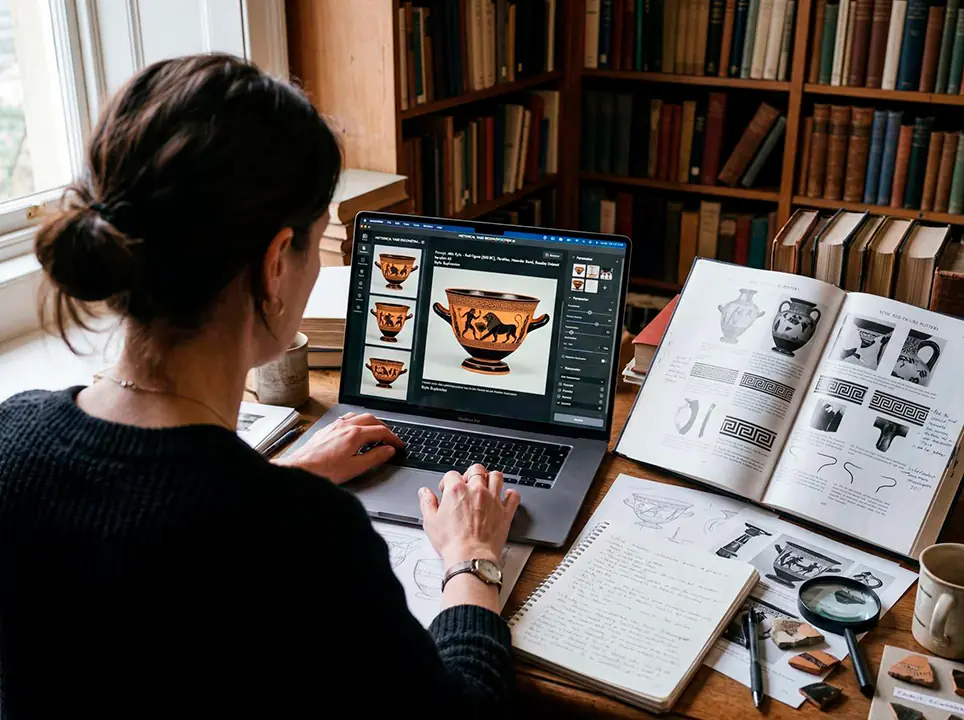
Therefore, historical reconstruction often involves:
-
research in historical sources
-
analysis of archaeological remains
-
study of original techniques and materials
-
practical experimentation
In many cases, this work is close to what is known as experimental archaeology., where the reproduction of ancient techniques allows us to test hypotheses about the life and technology of the past.
Today, in addition to the academic world, there are also studies specialising in audiovisual historical reconstruction that use digital technology to visualise the past with great precision.
What is historical re-enactment?
The historical recreation consists of representing or staging events, characters or ways of life from the past, generally with an informative, cultural or touristic approach. In this case, the aim is not always absolute fidelity, but to make the past understandable and attractive to the public.
Recreations may include:
-
staged historical battles
-
period military camps
-
historical fairs and events
-
representations of everyday scenes
Many re-enactments also involve a great deal of research and attention to detail, but usually allow certain licences to facilitate the performance or enhance the audience's experience. For this reason, although they share a solid historical basis, their purpose is usually more pedagogical and informative than experimental or investigative.
Differences between historical reconstruction and historical re-enactment
In recent years, interest in historical reconstruction and historical re-enactment has grown significantly, driven by documentaries, historical video games, audiovisual productions and new digital tools such as artificial intelligence.
Although the two concepts are closely related, there are some key differences:
| Aspect | Historical reconstruction | Historical re-enactment |
|---|---|---|
| Target | Reproduce the past with fidelity possible. | Representing the past in a comprehensible and attractive way. |
| Method | Historical research, source analysis and experimental archaeology. | Staging (and sometimes also research). |
| Rigour | Maximum fidelity to original fonts and materials. | It may allow for certain adaptations. |
| Context | Museums, research, experimental archaeology. | Cultural events, historical festivals, outreach. |
Target
- Historical reconstruction: seeks to reproduce the past as faithfully as possible.
- Historical re-enactment: seeks to represent the past in a way that is understandable and attractive to the public.
Rigour and method
- Reconstruction: is based on detailed research, analysis of historical sources and experimentation.
- Recreation: can also rely on historical research, but allows for more flexibility to facilitate representation.
Context of use
- Reconstruction: museums, research, experimental archaeology.
- Recreation: cultural events, historical festivals, public outreach.
In practice, however, the boundaries are not always strict, and many projects combine elements of both approaches.
Some examples
To better understand the difference, we can think of some concrete cases.
The making of a medieval sword following exactly historically documented techniques would be an example of historical reconstruction.
On the other hand, a public re-enactment of a medieval battle during a historic festival would be an example of historical re-enactment, even if it uses costumes and equipment inspired by real research.
In many events today, both approaches coexist: equipment can be based on very careful reconstructions, while staging is part of a re-enactment.
Two complementary ways of approaching the past
Rather than opposing concepts, historical reconstruction and historical re-enactment can be understood as complementary approaches to approaching the past. Reconstruction brings rigour and experimentation, while re-creation helps to make the past more accessible and understandable to the public.
Although the differences between the two practices are clear in theory, in practice they are often intertwined. A historical re-enactment can be supported by equipment or costumes developed from very rigorous reconstructions, while the results of a reconstruction can be used later in informational or educational contexts.
Thanks to both, it is now possible not only to study history, but also to experience and visualise it in a much more tangible way.
The role of technology and artificial intelligence in historical reconstruction and re-enactment
In recent years, new technologies are transforming the way the past is researched, reconstructed and represented. Tools such as the photogrammetry, 3D scanning or digital modelling allow archaeological artefacts to be studied with great precision and reproduced using methods that were previously not possible.
In this context, the artificial intelligence is starting to play an increasingly important role in the. Algorithms capable of analysing images, reconstructing visual patterns or generating digital representations can help to propose hypotheses about the original appearance of historical objects, buildings or landscapes from incomplete fragments or scattered documentation.
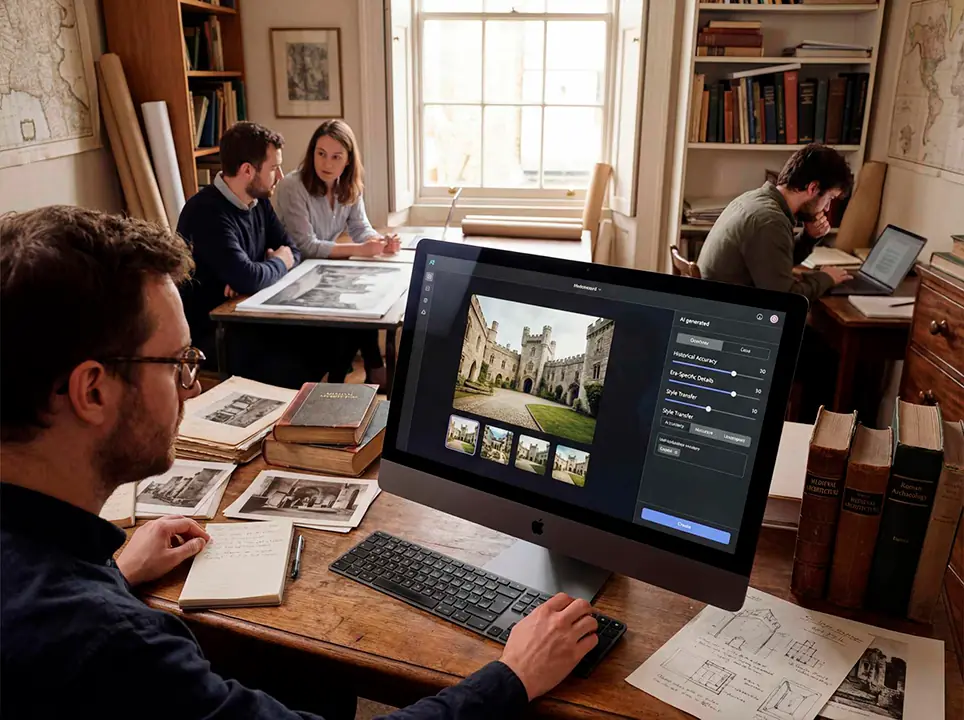
However, these technologies also pose new challenges. Digitally generated reconstructions - especially when they use generative artificial intelligence may be very convincing visually, but they do not always reflect verified historical interpretations..
Therefore, their use always requires a critical reading and the support of rigorous historical research. This is precisely the methodology and approach that we follow in Epopeia Studio, where we combine historical research, artificial intelligence and expert supervision to develop historically accurate reconstructions.
Understanding the past, representing it in the present
The way we represent history also influences how we understand it.. Therefore, distinguishing between historical reconstruction and historical re-enactment helps to better understand what is behind each project: from the research work to the way it is conveyed to the public.
Both practices, each from its own perspective, contribute to keeping interest in the past alive and to bring it closer to new generations. Whether through material experimentation or public representation, both approaches to history share the same goal: to make the past visible and comprehensible again in the present.
If you want to see concrete examples of how new techniques enabled by AI are being applied, you can explore some of our historical audiovisual projects, where we reconstruct scenes and contexts from the past with advanced digital post-production.